
As a business teacher, one of the key objectives is to prepare students for the workplace. While covering key concepts is essential, it is equally important to teach the soft skills students need to be successful in the future.
To develop workplace skills I recommend directly teaching the skill, applying the skill, and practicing the skill.
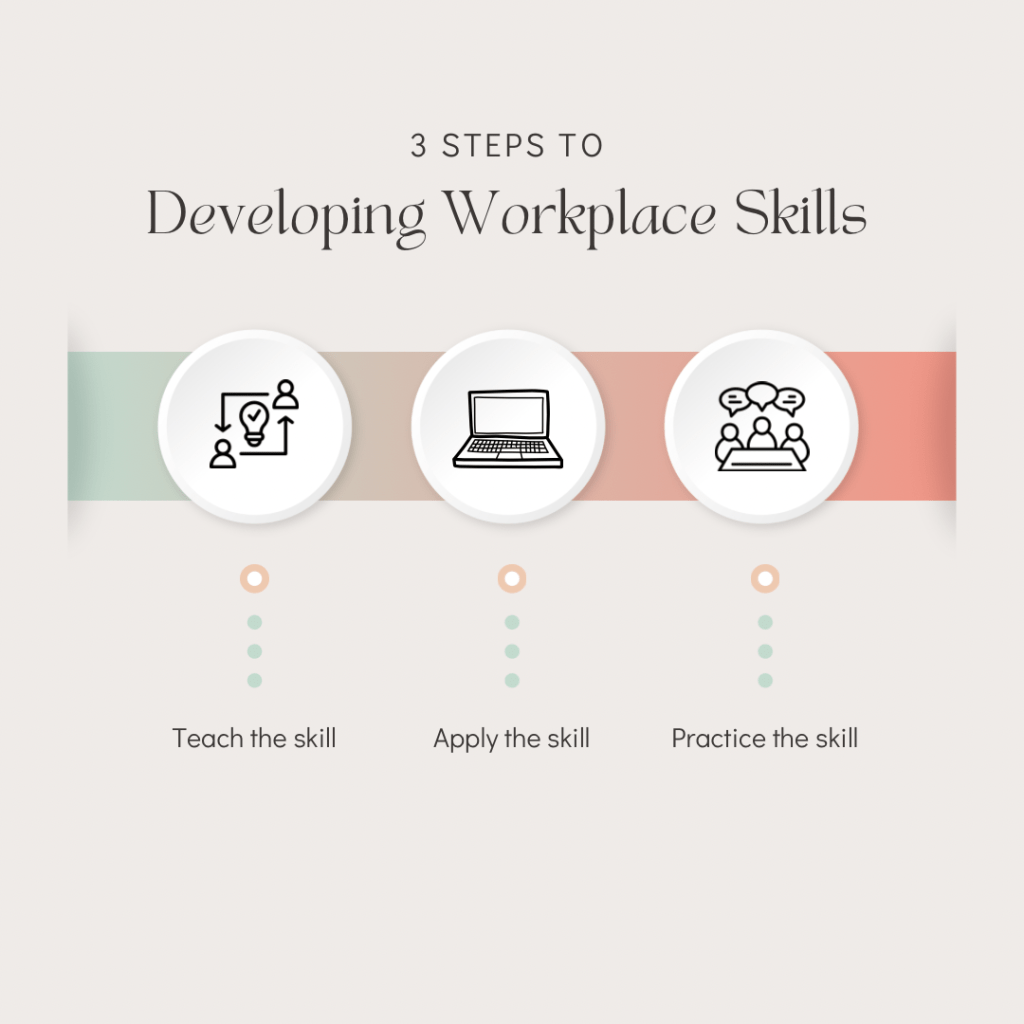
Teaching the Skill
The first step to developing workplace skills in your students is to teach the skill. This can be done through videos, articles, discussions, guided research, and other activities to reinforce the concept.
Break down the skill into manageable parts and make the skill relevant to students. Real-life examples can help them see the practical application of the skill in the workplace.
Applying the Skill
Once you have taught the skill, the next step is to apply it to real-life situations. This can be done through case studies, scenarios, simulations, or projects that require your students to use the skill. Applying the skill in a real-life situation helps your students to understand how it works in the workplace.
For example, if you are teaching problem-solving skills, you can provide your students with a real-life problem that they need to solve. You can then guide them through the process of identifying the problem, analyzing the situation, generating possible solutions, and evaluating the solutions. This helps them to see how problem-solving skills are applied in the workplace and how they can use them to be effective problem-solvers.
Practicing the Skill
The final step in developing workplace skills in the classroom is to provide your students with opportunities to practice the skill. This can be done through individual or group activities, or class projects. Practicing the skill helps your students to develop mastery and confidence in using the skill in different situations.
For example, if you are teaching teamwork skills, you can assign your students to work on a group project. This not only helps them to practice working as a team but also allows them to develop other skills such as communication, problem-solving, and time management.
When possible, provide your students with feedback and guidance to help them improve their skills. This can be as simple as a verbal comment in the moment, more detailed with written feedback, or as part of a project grading rubric.
By following the process of teaching the skill, applying the skill, and practicing the skill, you can help your students to develop mastery and confidence in using the skill in different situations.

What to Teach
While there are numerous workplace skills, here are 8 essential workplace skills to teach your students:
- Communication: Communication styles affect the way we interact with others. Whether it’s in the workplace or in our personal lives, it’s important to know strategies to improve communication. Start with the four communication styles (passive, aggressive, passive-aggressive, and assertive) and list the key characteristics of each. Next, have students explore strategies to improve communication.
- Leadership: Leadership skills are important for any career path, not just for those in management roles. Teach your students about various leadership styles such as autocratic, bureaucratic, coaching, democratic, laissez-faire, pacesetting, servant, transactional, transformational, and visionary.
- Conflict resolution: Conflict is inevitable in any workplace, but it’s important to be able to handle it professionally. Prepare students for the challenges of leadership and working in a team by discussing conflict resolution strategies and when they might be appropriate. Strategies could include avoiding, accommodating, competing, collaborating, and compromising.
- Negotiation: Negotiation skills are essential for any role that involves dealing with clients, vendors, or suppliers. Teach your students negotiating techniques/ strategies and skills. Students should develop an understanding of when employees would negotiate with other employees and when an employee would negotiate with an employer.
- Customer service: Regardless of the industry, providing excellent customer service is crucial for any business. Teach your students how to handle customer complaints and provide excellent service.
- Time management: Time is a valuable resource. Have your students explore the benefits of time management, problems with procrastination, the technology available to help with time management, improving concentration and focus, prioritizing tasks, getting and staying organized, and work-life balance.
- Goal setting: Setting goals is important for personal and professional growth. Have your students create a mission and vision statement for your course, set a short- and long-range S.M.A.R.T. goals for themselves, and visualize how to achieve one of their goals.
- Personal qualities: Understanding personal qualities can help students grow. With this skill, students should reflect on their own effectiveness in leadership, respect, punctuality, integrity, lifelong learning, perseverance, fitness/health, global perspective, initiative, work ethic, time management, teamwork/ collaboration, professionalism, conflict resolution, commitment, and competitiveness.
Resources to Teach Workplace Skills
Are you ready to take the leap and get started teaching these skills?
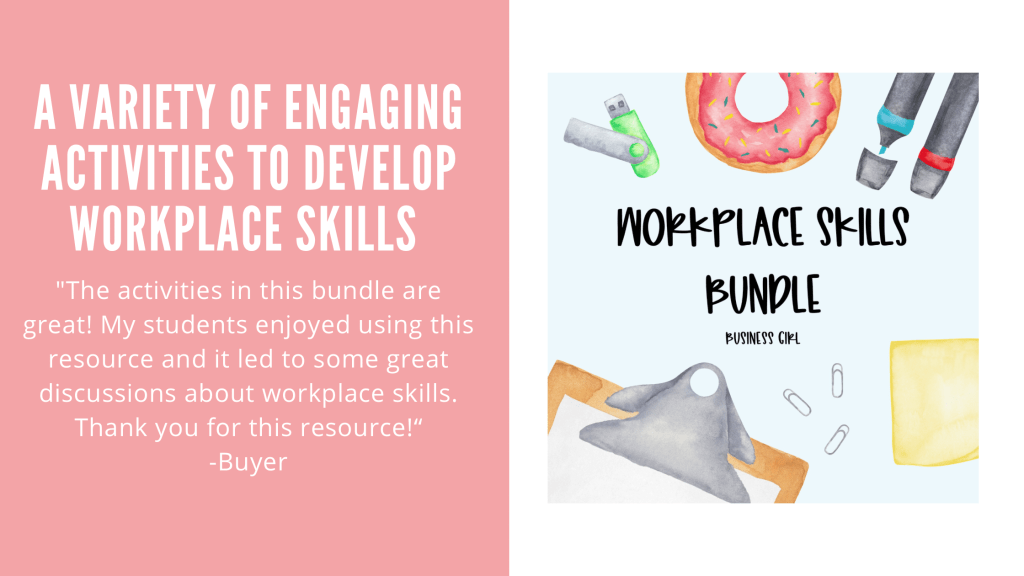
The Workplace Skills Bundle is a ready-to-use resource covering each of the 8 essential workplace skills. You can use the set as a unit, weekly lessons, or pick and choose your favorite skills.
This bundle includes a variety of activity and project types to keep your lessons fresh and engaging. Where possible, materials are offered in both a print and digital format to fit your classroom needs.
Take this 10-product bundle for a spin by applying business ethics, workplace culture, and a job description from a workplace to the relatable experience of the classroom. The FREE The Classroom as a Workplace Activity will help start the conversation about ethics, classroom culture, and student expectations with your students.
Other Ideas for the Classroom
Looking for ways to integrate workplace skills into your classroom?
Try these 12 ideas to make workplace skills relevant to students.
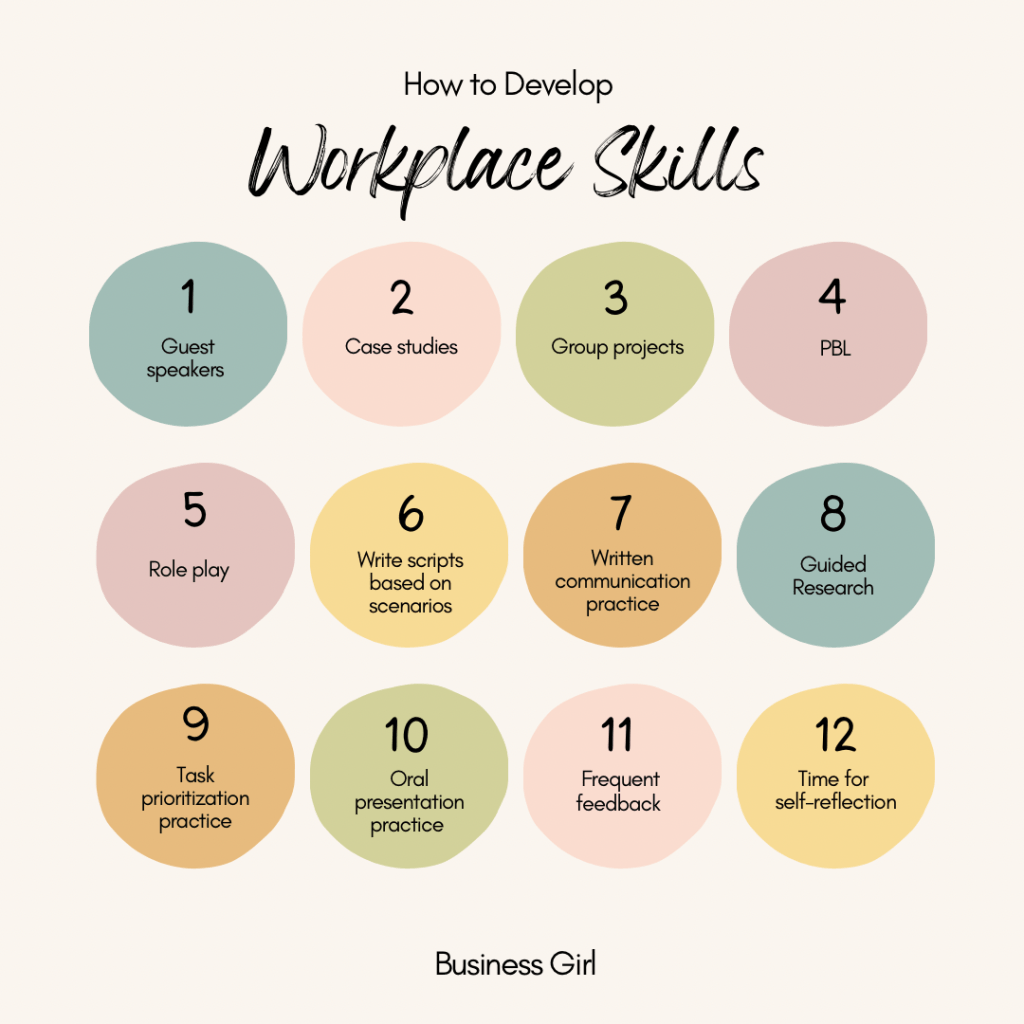
- Bring in guest speakers from various industries to discuss their careers and the soft skills that are most important in their industry.
- Use case studies and real-world scenarios to teach students how to apply workplace skills.
- Incorporate group projects and partner assignments in your lessons to help students develop communication skills.
- Use project-based learning to teach students how to manage their time and meet deadlines.
- Have students role-play good and bad examples of workplace skills. Students act out the scenario and classmates take notes on the interaction. Hold a discussion examining the activity.
- Have students write scripts or storyboards that put workplace skills into action. Discuss how to handle difficult situations.
- Teach written communication skills such as email, social media, letters, phone, and text.
- Assign a research project that has students complete a interest inventory to explore their own interests, strengths, and weaknesses.
- Set deadlines, but allow students to prioritize tasks and manage their time.
- Discuss presentation skills before having students present. Allow them time to practice and to receive feedback.
- Use peer evaluations to teach students how to give and receive constructive feedback in the workplace. Set specific parameters or provide prompts to avoid hurtful comments.
- Provide opportunities for self-reflection about how students have applied workplace skills in their personal and academic lives.
Conclusion
By incorporating these workplace skills into your classroom curriculum, you can help your students develop the skills that are in high demand by employers. These skills will not only benefit them in their future careers but also in their personal lives.
Prioritize teaching workplace skills, applying workplace skills, and encouraging your students to put these skills into practice. With your guidance, your students can develop the skills they need to thrive in a fast-paced workplace.

 Business Girl Education
One thought on “The Ultimate Guide to Developing Workplace Skills in the Classroom”