
Have you witnessed a student have a “light-bulb” moment? That spark of “I can do this”? They’re excited and you can almost see the connections building.
By applying course concepts to the real world, students build connections and see the concepts come to life in the world around them. Regardless of the business class you’re teaching, entrepreneurial concepts carry over from course to course. These concepts can help students develop problem-solving, creative thinking, and communication skills.
For a business education lesson to be effective, it must be relevant and applicable to the real world. This means that students can apply what they learn in the classroom to their everyday lives. High school students in particular need activities and projects that are engaging, enjoyable, and interesting for them to take away key concepts from the lesson.

Here are five ways teachers can make their entrepreneurship lessons real-world applicable:
1) Encourage students to research real businesses
By researching existing businesses, students can gain an understanding of how successful companies operate and what strategies they use. Students may take interest in a particular business that they know and love, or they may develop new knowledge about businesses in the world around them.
These businesses provide tangible examples of course concepts. This helps students better understand the material and encourages them to think more critically about the topics being discussed.
I find it helpful to provide students with a list of curated businesses that provide an effective example for the course concept being covered. Download the Logo Research & Timeline for a FREE example.

2) Use fictional business scenarios
By creating fictional business scenarios, you can help students better understand the complexities of the real world. These scenarios should be designed specifically for the lesson at hand and should include relevant details that will help students visualize what is being discussed.
Through these business examples, you can provide students with a more meaningful learning experience and give them a better chance of retaining the material you are teaching.
I like to structure the lesson with a section that has students research content and then apply what they’ve learned through fictional business scenarios. Try out the Logo & Color Palette Design Activity and Project for an example. Students start out by researching types of logos, color psychology, color codes, color palettes, and color combinations and then create a color palette and logo options for 3 business scenarios. Students respond to open-ended questions about branding, color choices, and logo choices for each scenario.

3) Act as the facilitator (instead of a performer)
Are you tired of feeling like you have to shoot fireworks during your presentation to get students to pay attention? Then you go to check for understanding, just to realize even your best students are mentally checked out?
Instead, try using activities and projects that give students the opportunity to take responsibility for their own learning. This makes them more likely to retain the knowledge they gain in class. You can find even more tips on facilitating here.
Skip the prep and grab the digital Entrepreneurship Activities and Projects Mega Bundle that can easily be integrated into your business course. You’ll love that you can customize the resources to meet the needs of your students and how easily you can post these materials to your LMS for a post-and-go experience. With these activities and projects, you can stop shooting fireworks from your fingertips and start taking on the role of the facilitator. Acting as the facilitator allows you to inspire meaningful discussions and connect with students.

4) Use current events
Using current events to make class topics come to life is an effective way of engaging students and helping them understand the real-world implications of their studies. By connecting the material they are learning in class with recent news stories, students can gain a better understanding of how course concepts apply to everyday life.
Use the FREE Business Current Events Article Review Graphic Organizer for any article. I like to provide students with a topic and have them find the article they’ll use for their review. After students have had time to complete the activity, have them share their findings with the class.
For more on using current events in the classroom, check out this post.
5) Apply key concepts through business simulations
If you’re not familiar with the concept, I consider a simulation as a deep-delve into course concepts with one cohesive project that runs throughout the semester. Each simulation contains several projects that can be used all together or that the teacher can pick and choose to only use their favorites. These projects apply key course concepts to a business concept and highlight student creativity.
The business world may not be easily relatable for all of our students but these projects help meet students where they are. For example, students may not find a topic such as financial statements meaningful when they are looking at another business, but when they are applying these concepts to their own business ideas it helps to make the content more applicable and relatable.
These projects can also be a great tool to get your local community involved in your classroom. This can be done in a variety of ways, such as having a guest speaker who is an event planner or guest investors come for business pitches with the Food Truck Simulation.
Business simulations allow students to imagine scenarios that may be difficult for them to experience in real life. By simulating a business environment, high school students can gain valuable insights into how businesses operate and what it takes to be successful. You can read more about business simulations here.
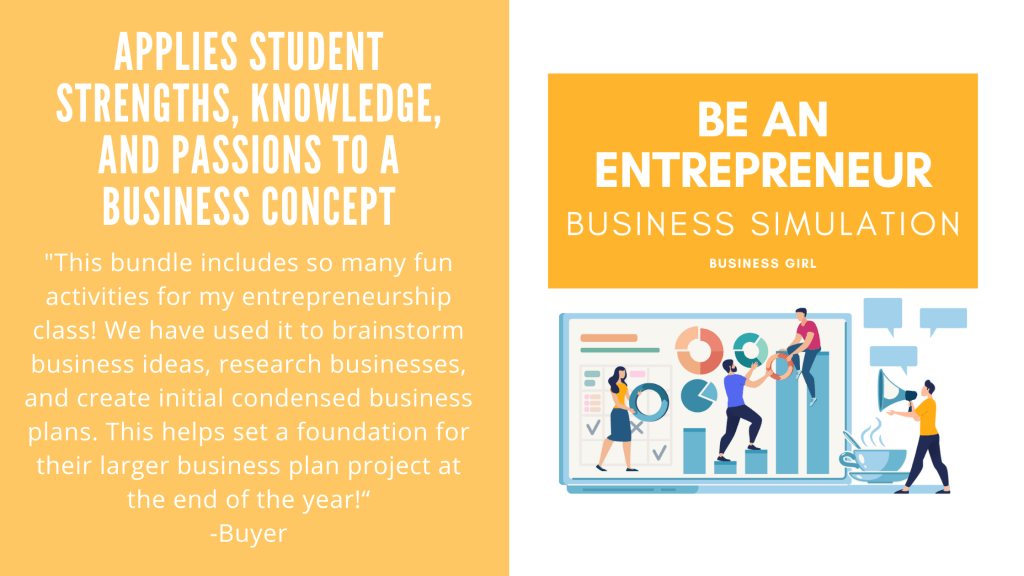
Looking for a ready-made simulation to engage your students? The Be an Entrepreneur Business Simulation was designed to make entrepreneurship realistic for high school business students. It evokes student interest, by having them apply their own strengths, knowledge, and passions to select a business concept that would be a good fit for them. Students will then apply key business concepts to expand on their business idea. Students will take ownership of their learning as they work through various course concepts and apply them to their business concepts.
Real-world applicable lessons help create a learning environment where students can engage with the material in a meaningful way. These lessons help students stay engaged and motivated while taking the pressure off the teacher to perform. As students gain insights into the world of business they will develop the skills and knowledge they need to be successful in their future careers.

 Business Girl Education
One thought on “5 Ways to Make Your Entrepreneurship Lessons Real-World Applicable”